Showing posts with label semiotics. Show all posts

Friday, 23 March 2012

Evaluation: Q2

2. How effective is the combination of your main product and your ancillary texts?
In order for my three products to work together I had to create a house style so it would be clear to the audience that they were all linked and advertising the same products. 
House style throughout the three texts
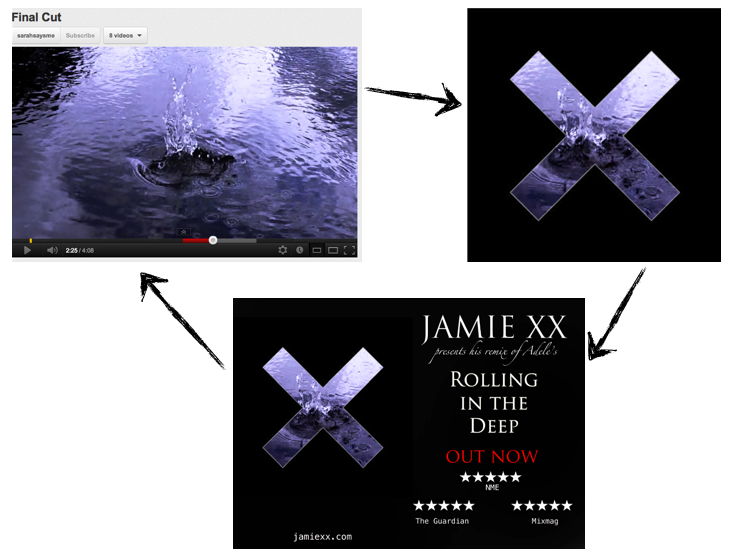
Images: The image of water was significant throughout my three products and was one way in which I tried to create a theme between them: it was a reoccurring motif which corresponds with the themes of the song itself. As the title of the song is ‘Rolling in the Deep’, this connoted to me water and the chaos that comes with it - reflecting the feelings of the protagonist. I’ve done this by taking a still from the video to use as my cover (which is an industry convention) that shows a pebble going into the water, part of a memorable section of the video, thus tying the two together. This splash can also symbolise the turmoil of feelings that the female protagonist is going through which is why I believe it to be a strong image in which to sell the song. 


Fonts: The fonts I used in the video itself connoted to be both youth and a more unique feeling which has impact as it can connect with the audience easier than simply using an Arial or Times New Roman font. I wanted a font that would catch the audiences eye which, corresponding with the quick editing, meant that it had a strong effect on the audience so they can anticipate the exciting video they’re about to see. 
Font I used in the video
In my ancillary I wanted to create a feeling of the artist being established as he is a relatively unknown artist but wanted the audience to trust him. I used relatively formal language and a simple layout to create a confident feel in the advert. Having no words at all on the cover was a risk but, as it is in keeping with the Jamie xx brand that he has already built up, it was the best way as his audience would then recognise that it is Jamie xx’s single and thus would already have a knowledge of his genre and quality of music.


Colours: The blue of the water is the dominating colour in my ancillaries which is complemented by the black and white base colours which connotes chic and sophistication. Black, white and red are the most common colours used in the music industry and so I used red to highlight the ‘Out Now’ feature of the advert which draws the audience’s attention to the fact that it is available to purchase.
I also used black and white in the interlude section of the video to contrast with the colours in the rest of the video. The black and white symbolised the serious emotional side to what she was saying and feeling in that section and so audience feedback told me that black and white would work here.
audience feedback which prompted me to try it in black and white
As a music video is created in order to promote a single (something I have already discussed) I had this in mind throughout the production process of both the video and the ancillaries. I included the jamie xx website in my advert as the 21st century is all about multi-platform media and so the audience (particuarly the target audience of 16-24 year olds) will definitely expect an internet presence which they can interact with and find out more, hopefully leading to buying the single. I shied away from featuring jamie xx’s facebook page or itunes as jamie is known for being a cool and elusive guy and thus simplicity in that case is key, leaving an air of mystery. 

Here is a video featuring many audience members being asked about my three texts...

Tuesday, 11 October 2011

Representation: Sexuality in Modern Music Videos

Female representation in the music industry
As I am filming using a female protagonist, I need to consider how females are shown to audiences. I made a conscious decision to go against the stereotype and clear conventions of representing females as sexual objects. While the successful female artists of today are seen as powerful and in control they are still often shown wearing very little clothing and using suggesting poses and dance moves.
Instead, I decided that as a dance remix, I have more freedom to be more artistic that following the pop route of sexualisation.
Here is some evidence of the sexualisation of females...
Of the Top 25 Album Selling Artists of 2010, only 7 were sung by single female artists.
Here I've included are the single covers of their biggest selling singles to show how they are represented...
Rihanna
Here the artist appears to be completely naked, and the title (which is provocative in itself) covers her up, she also seem to have a cigarette in her mouth a connotation of rebellion and self-destruction.
Lady Gaga
Here the artist is in a suggestive pose wearing leather which also has connotations of rebellion and 'rough' as it is traditionally seen on Bikers. She is also wearing a mask, which can be seen as seductive.
Alicia Keys
Here the artist is wearing a very low cut top showing her cleavage, otherwise her overall pose isn't necessarily sexual, which could mean she isn't signified by this.  
Susan Boyle
As Susan Boyle is much older she is already against the convention of a young female artist, so is more innocent, cupping her face, reflecting her genre of music.
Florence & The Machine
Florence & The Machine is a very indie genre and therefore her single cover very much represents this. She is shown as being ethereal and hippy like, while still having done up hair, make-up and glamorous red shoes.
Cheryl Cole
Here, the artist is going for a more simple single cover and has direct eye contact with the audience, reflecting the more intimate lyrics of the song. She is wearing a hat over one of her eyes, so is more mysterious. The background is also of lace which has connotations of underwear and innocence.
Katy Perry
Here the artist is in a very sexual pose and is wearing very little clothing. The patterned bra she is wearing highlights her body and her open mouth is suggestive. It is reminiscent of old style, retro pin ups.
One of the biggest selling artists of 2011 so far, is Adele, who is the female artist in my remix. 
She is one of the few exceptions to the rule of using her body to sell records and instead allows her incredible voice to shine instead. This is another reason why I decided to not sexualise my female protagonist. 


Why women still feel the need to represent themselves sexually in order to sell their music is an interesting question. While there is an air of change about gender equality, if you look at the entertainment business it is actually clear that very little has changed and that women either still feel that is how they must do it (pushed by the patriarchal leaders of the industry), or that they want to as a new kind of feminism. It is still a difficult issue and one that may take time to change.
There is, however, some evidence of change.
For instance Birdy, as a 15 year old, is represented very innocently, and rightly so, being so young. 


However so were females such as Miley Cyrus, but once she hit around 17/18 she suddenly started dressing much more provocatively in order to shake off this 'good girl' image, and, it would seem, sell more records. 
At 14 
At 17
Is this the fate awaiting young girls such as Birdy? Not necessarily, but they won't, typically, be very successful. Unfortunately in our present society the female sexualisation still seems to be how females are represented and the only (perceived) way to make a profit, but thankfully exceptions such as Adele, are slowly making progress, so that one day women won't feel the need to represent themselves in such a demeaning and oppressive way.

Monday, 12 September 2011

Rankin: Response

As I will be taking photographs during the shooting of my music video, taking good photos is an important skill. So as a response to looking at Magnum photography and, in turn, Rankin a well-known photographer, I think this has made me think more about the mise-en-scene and layout of my shots to make sure they have all of the visual codes needed to make every shot pleasing to look at. This activity has also made me think more about lighting and colouring which will be vital in the shoot as well as experimenting with camera angles.
Photography skills will also be important when it comes to my ancillary tasks also.


Rankin Response
First I took a few portrait photos of my mum, using quite bright, natural lighting. In terms of narrative and costume she wore a music note necklace to sum up her personality as she is a music teacher and a very musical person. I tried to keep things casual and to get natural expressions from her to make a more accurate portrayal of her. Throughout I tried to keep in mind Rankin and emulate his style. 


Here are some photographs from the first session.

Next, I wanted to play with light a little more and look at the visual codes that are important in media language. This includes colour, lighting, costumes, mise-en-scene and editing, as well as the composition of shots such as camera angles, layout and narrative.
I think these accurately capture my brother's personality, while also being relaxed and personal portraits.

Sunday, 26 June 2011

Semiotics

Semiotics
Semiotics is the study of signs and is the process of understanding signs and codes, interpreting what they signify.
There are three main figures who have a strong connection with the development of Semiotics; Ferdinand de Saussure, Roland Barthes and Charles Sanders Peirce.
Ferdinand de Saussure
(1857-1913)
Saussure was a Swiss linguist who is one of the founders of 20th century linguistics and semiotics. His concept of the sign/signifier/signified is the core of semiotics.
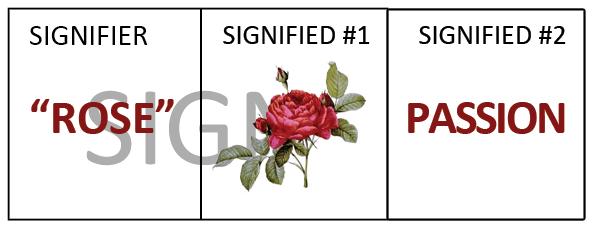
Signifier = the form which the sign takes
Signified = the concept it represents

 Denotation and connotation describes the relationship between the signifier and signified. 
Denotation (1st order of signification) is the literal meaning of a sign.
Connotation (2nd order of signification) is the socio-cultural and 'personal' associations of the sign, which are determined by 'codes'.


Charles Sander Peirce

(1839-1914)
Peirce was an American philosopher, mathematician, scientist and logician. He was also a founder of semiotics and called his general study of signs semiotic or semeiotic, which he began writing about in the 1860s, around the time when he devised his system of three categories. Later, in 1907 he defined semiosis as "action, or influence, which is, or involves, a cooperation of three subjects, such as a sign, its object, and its interpretant, this tri-relative influence not being in any way resolvable into actions between pairs".

The three basic elements to semiosis are:
1. A Sign
2. An object (subject matter of a sign and an interpretant)
3. An interpretant (the sign's more or less clarified meaning) 
In order to understand or interpret the object the mind needs to be familiar with it, so as to know what a sign denotes.

Roland Barthes
Semiotics became especially important in the late 1960's, party due to Roland Barthes, an important intellectual figure, who developed Semiotics further through his book 'The Death of the Author' and collection of essays 'Mythologies'. In 1964, Barthes declared that "semiology aims to take in any system of signs, whatever their substance and limits; images, gestures, musical sounds, objects, and the complex associations of all of these, which form the content of ritual, convention or public entertainment: these constitute, if not languages, at least systems of signification"
He looked at how the audience interprets meaning, which is influenced by each individuals own background and experience. 

Jean Baudrillard
Baudrillard built on Saussure's ideas that meaning is given through systems of signs working together, but he argued that meaning is created through difference - through what something isn't. He felt that the excess of signs and meaning in late 20th century had caused society to become a 'hyperreality' of itself. It is a 'simulated' version of reality, where the media can shape and filter events and experiences so that consciousness can no longer truly define what is actually 'real'. The media's 2D version of the world has become naturalised to us as we have grown up to read their images as realistic.

Representation
This then leads to representation as, after all, media texts are a representation of reality; the process by which the media present to us the 'real world'. If this reality is in fact a 'hyperreality' this can seriously impact society, leading to issues such as stereotyping because, for many, how they see the world is through the media's non accurate portrayal. The process through which the media represents issues, ideas and events, is called mediation.